Taking Care of Your Child's Teeth
Baby teeth are important and need to be protected from tooth decay from an early age. Children who experience tooth decay or lose baby teeth too soon are more likely to have dental problems as their adult teeth come in. The good news is that tooth decay is often preventable, and there are simple ways you can help protect your child's teeth.
Start by exploring the information below to learn what causes tooth decay, how to brush your child's teeth, and how oral care changes as your child grows. Then, use the navigation menu to find additional resources and tools to support your child's oral health.
What is Tooth Decay and How Does it Happen?
Tooth decay is a disease that causes teeth to break down. It can lead to pain, infection, and problems eating or speaking.
Tooth decay can happen when two things come together on a tooth:
Sugars, starches or simple carbohydrates. Foods with simple carbohydrates include:
White bread
White pasta
Cakes, pastries and many baked goods
Packaged cereals
Germs (bacteria) that live in the sticky film that forms on teeth every day and make them feel fuzzy, often called plaque
When the germs in the plaque come in contact with sugary and starchy foods, acid attacks the teeth, breaking them down. The acid is what breaks down the teeth, leading to tooth decay. If left untreated, this can then cause holes (cavities) in the teeth. The germs in the plaque are the enemy!
Did You Know?
The germs that cause tooth decay can be passed from a caregiver to a child through saliva. As a result, avoid sharing spoons, cups, straws, or toothbrushes with your child and clean pacifiers with water instead of putting them in your mouth.
There Are Many Ways to Take Care of Your Child’s Teeth
You can protect your child’s teeth with 4 simple steps:
- Toothpaste: Use toothpaste that contains fluoride. Twice daily brushing with fluoride toothpaste protects teeth from tooth decay
- Fluoride Varnish: Have a medical doctor, dentist, dental hygienist or nurse apply fluoride varnish to your child’s teeth to help prevent tooth decay and even reverse early tooth decay
- Diet: Serve healthy foods and avoid sugary drinks and snacks
Dental Checkups: Have a medical doctor or dentist check your child’s teeth by age one and then on an on-going basis. Visit the resource below to learn more about early childhood dental visits
Tips on Caring for Your Child’s Teeth and Mouth Based on Their Age
Before Teeth
Even newborn babies need to have their mouths cleaned. Before your baby has teeth, gently wipe the gums clean with a clean, damp washcloth each day.
When Teeth Appear – usually around 6 to 9 months
- The lower teeth usually come in first. Once they do, brush teeth twice a day with a small amount of fluoride toothpaste the size of a grain of rice using an infant toothbrush
- You can brush your child’s teeth anywhere – not just in the bathroom. It can be easier to brush a baby’s teeth while he/she is lying down on a changing table or on the floor
- Introduce a sippy cup when your child can sit up on his/her own. Limit juices, breast milk and formula to mealtime only
- If you put your baby to bed with a bottle, fill it with water only. Milk, formula, juices, soda and breast milk all have sugar in them that can puddle around a sleeping baby’s teeth, causing tooth decay
1-3 Years Old
- Continue to brush teeth twice a day with a small amount of fluoride toothpaste, the size of a grain of rice
- Allow your child to decide where tooth brushing will take place
- Make brushing teeth fun by singing for two minutes, using a tooth timer, or watching a tooth brushing video online
- Allow your child to choose his or her own toothbrush and toothpaste at the store
- Ask your child’s medical doctor or dentist about a simple fluoride application that can be given at the office
- Wean baby from the bottle by age 1. Now your baby should be drinking water from a sippy cup. Offer your child milk in a sippy cup during mealtimes as well as a maximum of 4 ounces of 100% fruit juice per day. When your child is not having a meal, the sippy cup should only contain water
- Check your baby’s teeth for spots and stains. Ask your child’s medical doctor or dentist about any problems you notice
- Children should have their first dental check up by age 1. Schedule a visit with a dentist or ask your child’s medical doctor to look at their teeth
3-5 Years Old
- Brush your child’s teeth twice a day with a small amount of fluoride toothpaste
- Your child can now use a little more fluoridated toothpaste than before – the size of a pea
- When purchasing toothbrushes, be sure that they are the correct size for your child. As your child grows, the toothbrush you use should grow too
- Let your child start learning to brush his own teeth, but be there to help
- Ask your child’s medical doctor or dentist about a simple fluoride application that can be given at the office
- Limit juice drinks to 4-6 ounces per day to help prevent tooth decay
- Start flossing your child’s teeth once a day as soon as he/she has two or more back teeth that touch
- Schedule visits with your child’s dentist
- At 4 years old, your child's jaw and facial bones will likely grow to make space between the baby teeth so that adult teeth have room to come in
6-12 Years Old
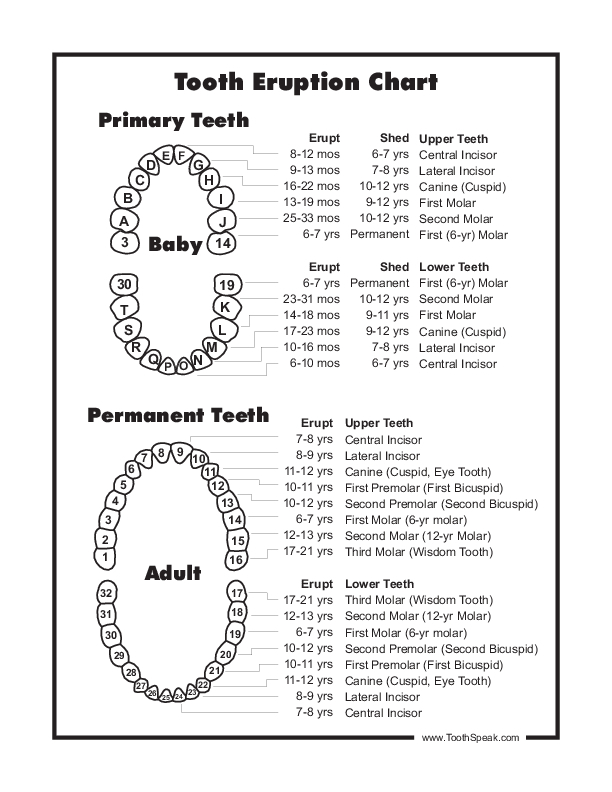
- Between the ages of 6 and 12 years, your child will start losing baby teeth. During these years, your child’s smile will have both adult and baby teeth
- Usually the middle teeth (central incisors) are the first to come out around age 6 to 7 years
- The ones on the sides of the middle teeth (lateral incisors) come out around age 7 or 8
- Molars and canines can be lost at any time after age 8, and will be gone by age 9 to 12
- Around age 12 years, your child will have a set of 28 permanent, adult teeth
- Be sure to inspect your child’s teeth for signs of decay. If you see something that concerns you, call a dentist right away